
Buying guides
BNC Adapters for CCTV: RCA, T Splitter and Coupler
An adapter changes the connector or joins two cables, not the signal. See which BNC adapter does which job in a CCTV system.
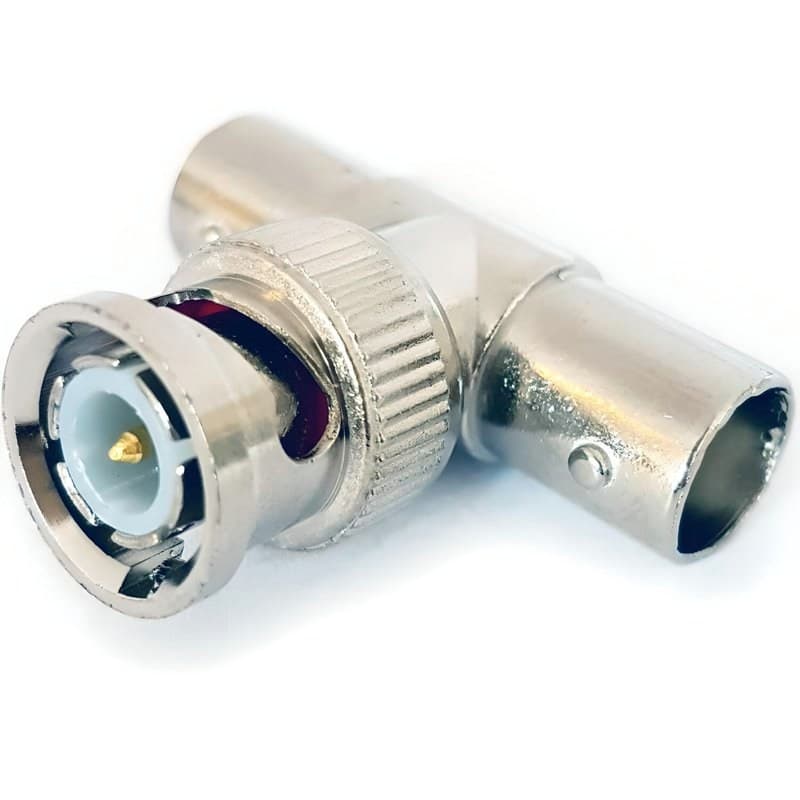
A BNC adapter changes the connector or joins two cables; it does not change the signal. Use a BNC to RCA adapter to meet a monitor or DVR input that takes RCA, a T splitter to feed one camera output to two devices, a coupler to join two BNC cables, and a ground loop isolator when the picture shows rolling lines. If you need to know which plug to fit to the cable, read our guide to BNC connector types first.
BNC to RCA: male or female
RCA is the phono connector on many monitors, DVRs and AV devices. The BNC male to RCA female adapter plugs into a BNC socket and gives you an RCA socket, for CCTV equipment feeding a device with an RCA input. The BNC female to RCA male adapter goes the other way: it plugs into an RCA socket and gives you a BNC socket for a coaxial cable. Both are metal, work inline and are listed for analogue composite video, including HD-TVI, AHD and CVI formats on RG59 and RG6 coax.
T splitters: one output, two devices
Our BNC 3-way T splitter has one male BNC and two female BNC ports, so a single camera output can reach two devices, such as a recorder and a test monitor. We also list a three-female T adapter, with three female ports in a T shape, for splitting or combining signals on coax. Both are listed for RG59 and RG6 cable and for analogue, HD-TVI, AHD and CVI.
Couplers: joining two BNC cables
Two BNC-terminated cables join with a coupler, without re-terminating either end. The BNC female to female coupler joins two cables that end in male BNC plugs, the usual case on a camera lead. The BNC male to male coupler joins two female BNC ports. Both are listed for RG59 and RG6 coax and for analogue, HD-TVI, AHD and CVI. A coupler is a connection point, so keep it somewhere dry, such as inside a junction box.
Ground loop isolator: for rolling lines
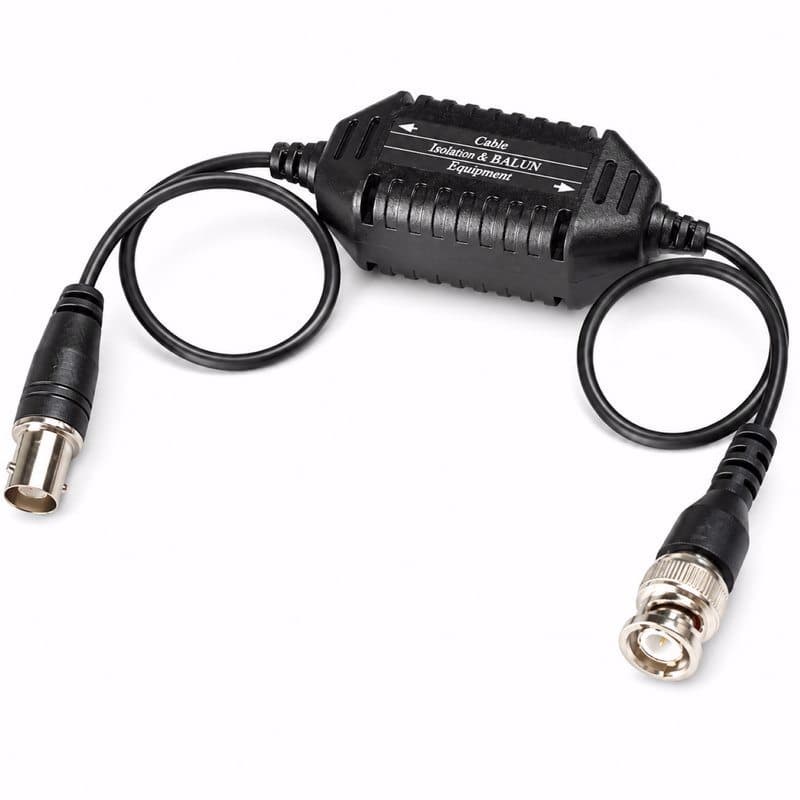
A ground loop can show on screen as distorted images and rolling lines. The BNC ground loop isolator fits between the camera and the recording device on BNC connectors and breaks the ground loop to cut that interference. It is for interference only: if the picture has no rolling lines, you do not need one.
Baluns: BNC to network cable
A balun is not a plug adapter, but it is the other BNC part people look for. The passive video balun pair puts a BNC connector on one side and a UTP terminal on the other, so analogue and HD-over-coax video can travel over Cat5e or Cat6.
What an adapter cannot fix
An adapter does not make a camera and recorder speak the same video format: the camera type has to match what the recorder accepts. It also does not make a cable run longer than the cable allows. Our guide to CCTV cable length sets out the limits. Every extra connector is one more joint in the run, so use as few as the job needs. Ask us before ordering if you are not sure which adapter fits your equipment. The full connectors range lists the plugs and adapters together.
Parts named here
- Part number BNC-T-SPLITTERBNC 3-Way T Splitter, Male to Dual Female Metal Adapter for RG59 and RG6 CCTV Cable
- Part number BNC-ISOLATOR-GB001BNC Ground Loop Isolator GB001, 75 Ohm, Reduces Video Interference on CCTV Coax
Frequently asked questions
Is a BNC to RCA adapter the same as a video balun?
No. A BNC to RCA adapter changes the connector on a coax cable. A balun carries the video over Cat5e or Cat6 network cable instead.
When do I need a ground loop isolator?
When the picture shows distorted images or rolling lines caused by a ground loop. It fits between the camera and the recorder.
Can a T splitter send one camera to two devices?
Yes. Our BNC 3-way T splitter has one male BNC and two female BNC ports for that job, on RG59 or RG6 coax.
- BNC adapter
- BNC to RCA
- T splitter
- coupler
- ground loop isolator
Written by
CCTV Gear team