
Fit check
PoE cable run
One camera run, two checks. PoE: run length against 100m and camera draw (W) against the device budget. 12V DC: volt drop (V) over the copper loop. A failed run returns its fix.
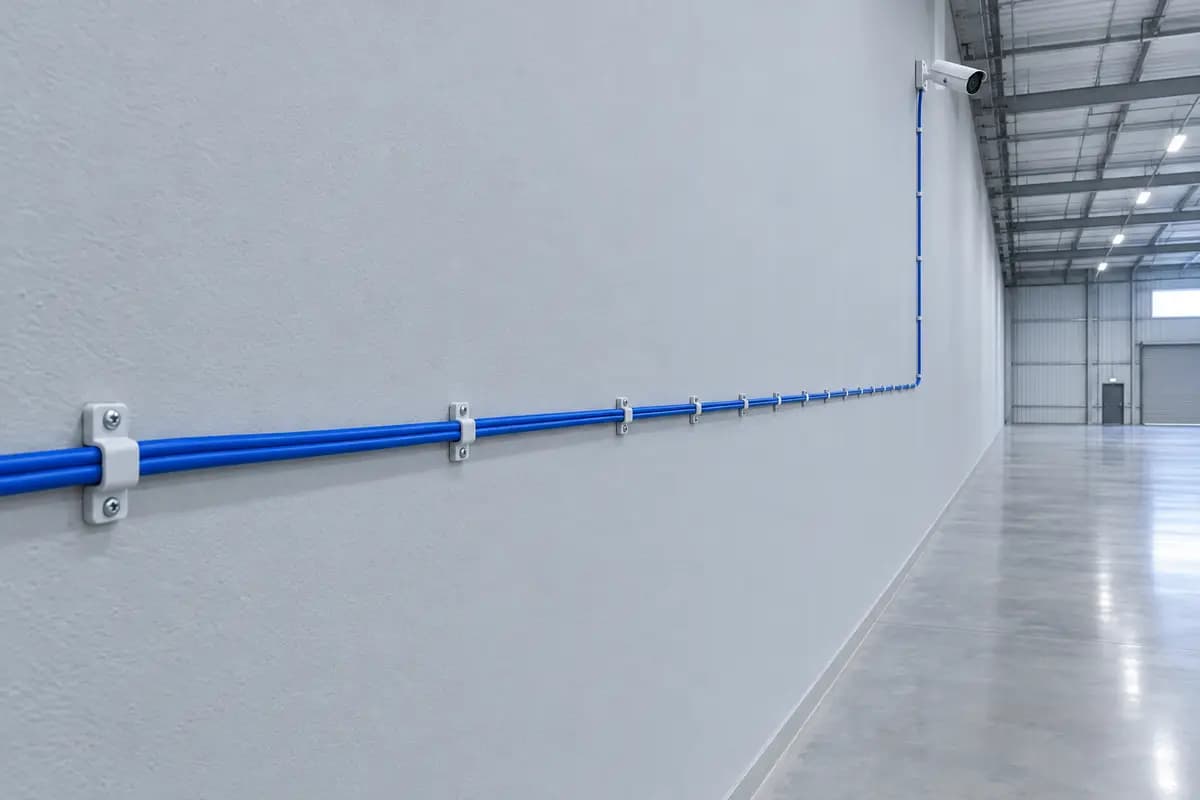
Within spec
- Run: 30m. Ethernet limit: 100m. Within limit.
- Load 6W; 802.3af (PoE) budget 12.95W; headroom 6.9W.
- Also check the switch total: 8 cameras at full draw can exceed many 8-port switches’ combined PoE output.
PoE switches listed
Networking: all- 4 portGoodTop 4-Port Gigabit PoE Extender, 1000M, IEEE 802.3af/at, 100m Extension£14.26
- 8 portHikvision DS-3E0510P-E 8-Port Gigabit PoE Switch for IP Cameras, 110W Power Budget£76.70
- 9 portHikvision DS-3E0109P-E/M 9-Port PoE Switch, 8 PoE Ports, Fan-Free Metal Body, 300m Extend Mode£55.14
- 16 portHikvision DS-3E0318P-E/M 16-Port PoE Unmanaged Network Switch, 130W, SFP Uplink£195.41
- 24 portHikvision DS-3E0326P-E/M 24-Port PoE Unmanaged Network Switch, 230W, SFP Uplink£197.62
Watts before ports: add up the camera draws (W) and keep the total inside the switch’s whole-unit PoE budget.
Limits and figures
PoE reach: 100m on Cat5e or Cat6. Power at the camera by standard: 12.95W (802.3af), 25.5W (802.3at), 51W (802.3bt). Typical failure point: the switch total. Sum of camera draws (W) must sit inside the whole-unit PoE budget; a per-port rating alone is not the check.
12V DC runs are limited by copper. Volt drop rises with run length, counted twice because current goes out and back; one conductor size up halves it. Camera tolerance: roughly −10% (10.8V). With IR on, draw can double after dark, so 3pm readings can pass and midnight ones brown out. Options for a failing run: PoE instead, 24V equipment, a PSU mounted near the camera, or thicker cable.