
Buying guides
Turret or Dome Camera: Which One Suits Your Site
A turret gives cleaner night images and is easy to aim. A dome is discreet and harder to tamper with. See which suits your site and what we list.
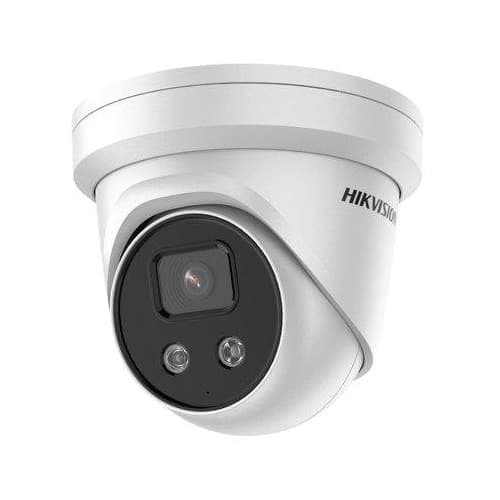
Choose a turret camera when night-time image quality and easy aiming matter most, and a dome camera when the camera must be discreet or hard to tamper with. A turret has an open lens on a ball-and-socket mount, so infrared light cannot bounce back off a cover. A dome sits under a clear shell that hides the lens and keeps hands and weather off it. Most of what we list is turret, with one dome-style IP camera and one speed dome.
What each one is
A turret camera has a ball-and-socket mount. After it is fitted you can turn the lens to get the view you want, and there is no protective enclosure over it. A dome camera keeps the lens and parts inside a clear dome-shaped shell (Avigilon's turret and dome comparison). Both mount on a wall or ceiling, so the choice is about what happens at night, who can reach the camera and how much you want it noticed.
Infrared glare at night
Infrared night vision lights the scene from LEDs next to the lens. On a dome, that light can bounce back off the clear shell and reduce image clarity. Avigilon says turret cameras perform better at night for that reason (Avigilon). With nothing in front of the lens, a turret avoids the problem. If the camera will watch a dark yard, a car park or a drive at night, that points to a turret.
Reach and vandals
The same open lens is the turret's weak point. Avigilon notes that with no enclosure, someone who can reach a turret can turn it away or damage it, while the dome shell makes it harder to move or cover the lens. So a camera mounted low, by a pub yard or a school entrance, suits a dome. Out of reach, under a soffit or high on a wall, a turret is a fair risk. A dome is also less obvious, which suits a shop or reception where you do not want visitors to feel watched; a turret is easy to see, and that can put people off.
Ceilings, walls and aiming
Both go on walls and ceilings. A turret is easier to aim: loosen it, turn it, tighten it. A dome is not adjustable once fitted, and Avigilon notes that improving its coverage means re-installing it. Where the view may change, a turret saves time. For a fixed wide view in a corridor or room, a dome does the job.
What we list
Most of our fixed IP cameras are turrets. The Hikvision DS-2CD3356G2-ISU is a 5MP AcuSense turret with a fixed 2.8mm lens, infrared up to 40m, PoE and an IP67 metal housing. Our dome-style IP camera is the 5MP AI IP dome camera LWA28PW-C3, with 30m infrared, PoE and an IP67 and IK10 metal housing. We also list a Hikvision 4-inch analogue speed dome, the DS-2AE4225T-A, which pans, tilts and zooms and is a different job from a fixed dome. Browse the IP camera range and look for turret or dome in the name.
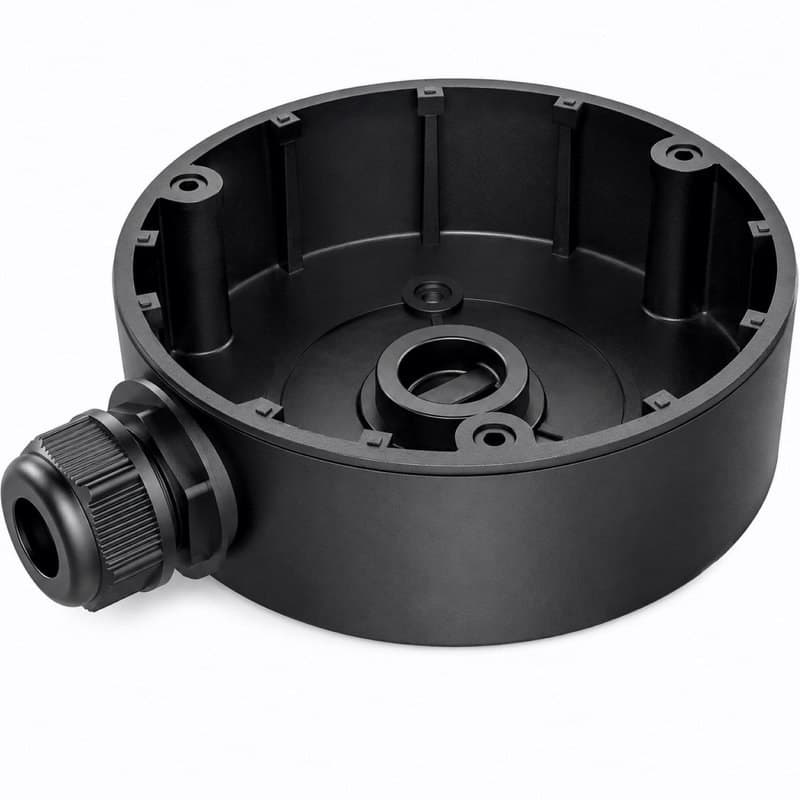
Turrets and domes use different junction boxes. We list the DS-1280ZJ-TR13-B junction box for turret cameras, and several for dome cameras in the bracket and junction box category. Ask us before ordering if you are not sure a box fits your camera.
Parts named here
- Part number DS-2CD3356G2-ISUHikvision DS-2CD3356G2-ISU-2.8MM-W 5MP Turret Camera 2.8mm, IP67
- Part number DS-1280ZJ-TR13-BHikvision DS-1280ZJ-TR13-B Turret Camera Mounting Base, Black Aluminium Alloy
Frequently asked questions
Is a turret camera better than a dome camera at night?
Usually yes. A turret has no cover for infrared to reflect off, so night images stay clearer. A dome can bounce infrared back off its shell and lose clarity.
Which is harder to vandalise, a turret or a dome?
A dome. Its shell covers the lens, so it is harder to turn away or cover. A turret is open, so mount it out of reach.
Can I move a camera's view after fitting it?
A turret can be turned on its ball-and-socket mount without refitting. A dome is not adjustable once fitted, so a new view means refitting it.
Sources & references
Part types on this subject
- turret camera
- dome camera
- IP cameras
- camera mounting
- infrared
Written by
CCTV Gear team